
DRONES AND SMALL UNMANNED AIRCRAFT (SUA)
In the United Kingdom, flights of unmanned aircraft around aerodromes that are designated as ‘protected aerodromes’ are restricted.
Unmanned aircraft of any size must not be flown within the Flight Restriction Zone (FRZ) of a protected aerodrome, without appropriate permission.
Air Portal manages all drone requests on behalf of London Oxford Airport.
Visit Air Portal to make your drone request.

Flight Restriction Zone (FRZ)
You must not fly a SUA within the flight restriction zone of a protected aerodrome without obtaining permission. London Oxford Airport is a protected aerodrome.
See below Diagram showing the Flight Restricted Zones around London Oxford Airport.
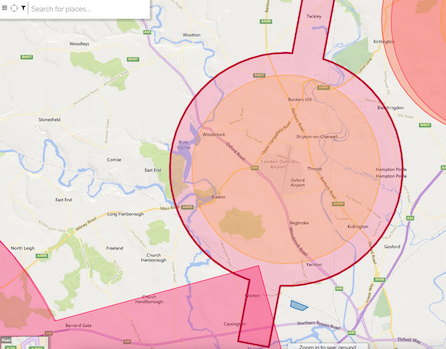
The flight restriction zone is active at all times (H24) and applies to all small, unmanned aircraft of any mass, even small toys.
Having received approval for your request, during Oxford Air Traffic Control’s hours of operation (06:30-22:30 local times, or as notified by NOTAM) final permission must be obtained from the Air Traffic Control Officer (ATCO) on duty.
Outside ATC hours, permission must be obtained from the aerodrome operator. If permission cannot be obtained the flight may not take place.
The Drone Code
When you fly a drone in the UK, it is your responsibility to be aware of the rules that are in place to keep everyone safe. Follow these simple steps to make sure you are flying safely and legally.
FLYING DRONES SAFELY AND LEGALLY
When you fly a drone in the UK it is your responsibility to be aware of the rules that are in place to keep everyone safe.
Drone Access Policy (UK only):
The drone pilot must be aware of and comply with the law relating to safe and legal operations, this includes:
- Air Navigation Order 2016
- CAP722A; and
- The UK Civil Aviation Authority (CAA) Drone Code.
All drone pilots must:
- Operate only within the area authorised by the airspace owner
- Make sure that anyone flying under their operator ID is sufficiently competent to undertake the operation safely and legally.
- Make sure that flyers have planned and will carry out flights safely and legally
- Keep any software on the drone or model aircraft up to date, including any information on airspace restrictions.
- Make sure pilots are aware of any airspace restrictions through GuardianUTM such as www.dronesafetymap.com or Drone Assist Apps (iOS and Android).
- In the case of European Class marked drones or model aircraft, make sure the class mark is not removed.
- Apply the appropriate level of experience, skills, and resources to manage safety risks effectively; the more complex or risky a proposed operation is, the more extensive and detailed the planning and oversight of the proposed operations must be.
Actions:
- Read the aircraft instruction manual carefully.
- Register as an operator (this is a legal requirement for all drones or model aircraft weighing 250g or over; and for all drones or model aircraft with a camera, apart from toys).
- Label their aircraft with their Operator ID.
- Demonstrate competence through training, either through a valid FlyerID or CAA-approved training course through a UK Recognised Assessment Entity (RAE).
- Look after their aircraft to ensure it is in safe working condition to fly.
- Where required, insure the aircraft or make sure the correct insurance cover is held.
- Carefully decide when and where the aircraft will be flown.
- Carefully decide who may fly their aircraft.
- Ensure the remote pilot is competent to carry out the flight safely and legally.
- Plan your flight carefully to minimise risk and reduce the chance of something going wrong.
REPORTING SAFETY CONCERNS ABOUT DRONES
If you have any concerns about drones being used in vicinity of London Oxford Airport either from a safety or privacy perspective, contact your local police on 101.